
Barcelona gave Guardiola the B team in 2007. Not the first team. The reserves — fourth tier, Tuesday evenings in half-empty stadiums, players who mostly weren’t going to make it. For someone who’d spent eleven years as Cruyff’s on-pitch brain, absorbing positional theory from the man who basically invented the modern game, this was the starting point. He didn’t make a fuss. Won promotion. Left. Txiki Begiristain watched the whole thing and decided that was enough evidence to hand him the actual squad. First season as a senior manager ended with the treble — La Liga, Copa del Rey, Champions League — first time any Spanish club had done it. Messi was 21 and already operating in a system specifically designed around the fact that no defence had ever encountered it before. For anyone tracking what performances like that mean for betting markets and odds across European football,dbbet has the data.
Guardiola grew up in Santpedor. Tiny town, Catalonia, the kind of place that produces either farmers or footballers depending on the decade. La Masia took him at thirteen. He wasn’t the best player in his generation there — he’d be the first to say it — but Cruyff watched him read the game and decided that mattered more than pace or technique. Eleven years at the club as a player. Six league titles. One European Cup. A front-row education in why football is mostly about where you stand before the ball arrives. All of that is still visible, recognisably, in every squad he’s coached since regardless of country or budget. Historical stats and match data across every club from that career are atwekawin.
Table of Contents
Before Anyone Was Writing Long Profiles About Him
After Barcelona the playing career went sideways geographically if not disastrously — Brescia, Roma, a season in Qatar with Al-Ahly, then Dorados in the Mexican second division. None of it was glamorous and none of it needed to be. He retired in 2006. Thirty-five. Holding midfielders who never ran particularly fast tend to last longer than wingers, but there’s still a ceiling.
Barcelona B. One season. Promotion from Segunda División B. Then Begiristain called.
The 2008–09 season is still strange to read about flatly. First year with a senior club. First treble in Spanish football history. The false nine built around Messi worked as well as it did partly because no defensive coaching staff on earth had a prepared answer — Messi wasn’t playing where strikers play. He was collecting the ball in the gap between midfield and attack, a zone with no clear owner. Track him and leave space behind. Stay and watch him receive the ball with nobody within ten yards. Neither option was survivable at his level. Teams tried both and it didn’t matter.
Every Club, in Order
| Club | Country | Years | Result |
| FC Barcelona B | Spain | 2007–2008 | Promoted from Segunda División B |
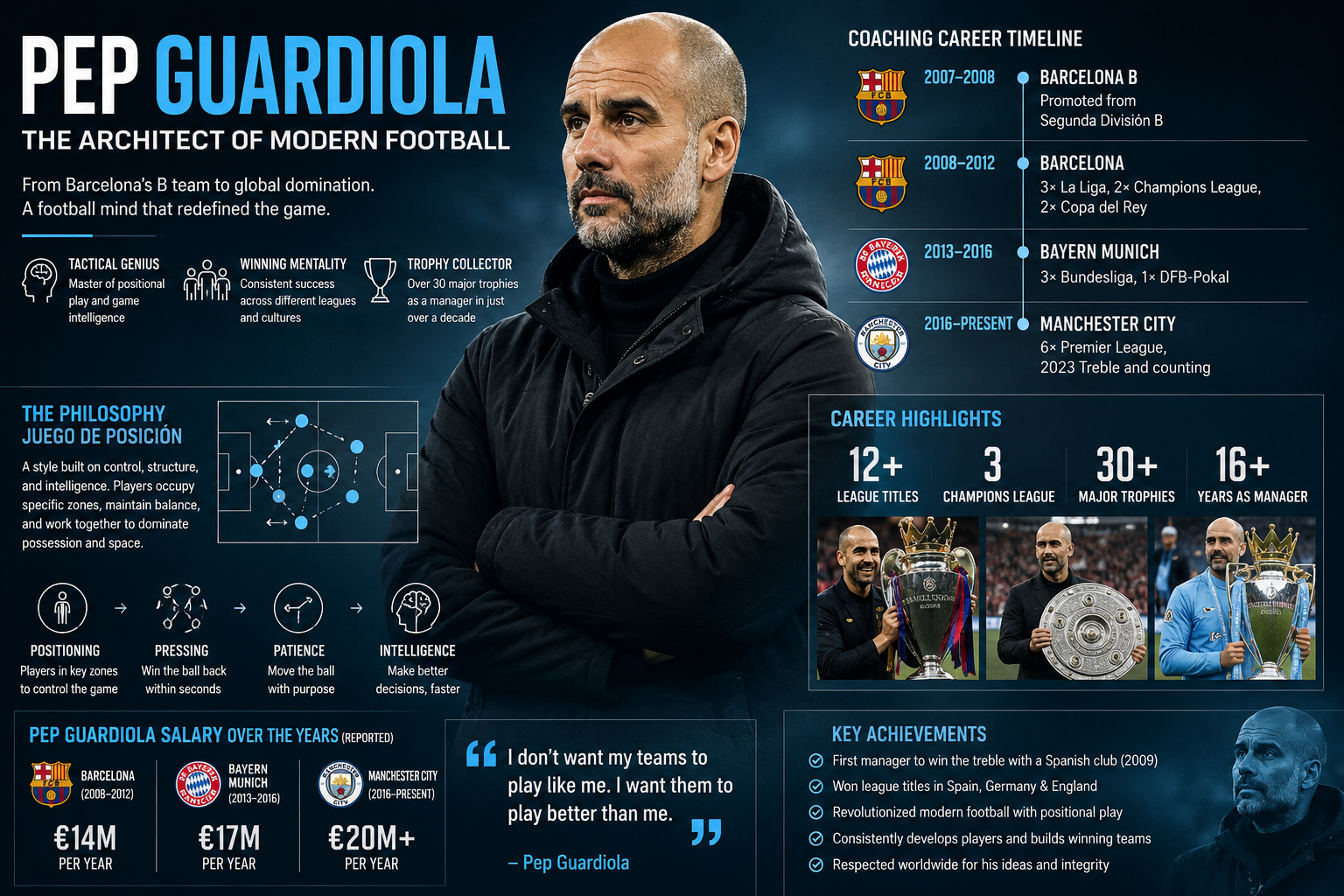
| FC Barcelona | Spain | 2008–2012 | 3× La Liga, 2× Champions League, 2× Copa del Rey |
| Bayern Munich | Germany | 2013–2016 | 3× Bundesliga, 1× DFB-Pokal — Champions League stayed out of reach |
| Manchester City | England | 2016–present | 6× Premier League, 2023 treble, still running |
Bayern. The chapter that gets rewritten constantly depending on who’s doing the telling. Three consecutive Bundesliga titles — which, for the record, isn’t easy, plenty of well-funded clubs have spent years trying to stop Bayern winning that league and walked away with nothing. The problem wasn’t what got won. It was the Champions League: three semi-finals, nothing beyond them, at a club where the competition is treated less as an ambition and more as a scheduled appointment. The departure in 2016 was called mutual. That word in football tends to carry a fairly specific meaning.
City’s first season — 2016–17 — gets quietly removed from most retrospectives because 2017–18 was so dominant it makes the year before look like a footnote. Third in the league. Monaco in the Champions League quarters. Guardiola described it as a failure in press conferences, which was at minimum honest. The club backed him through it, spent heavily that summer on Ederson, Walker, Mendy, Bernardo Silva, and what followed was 100 points, 32 wins, 106 goals. English football hadn’t produced anything like it. The title was essentially over by Christmas.
The System, Explained Without the Jargon
Juego de posición is the phrase that appears in every profile written about Guardiola and gets properly explained in approximately none of them.
Ground level: players don’t drift wherever space appears. They hold specific zones designed to force the opposition into positions where they’re either outnumbered or making decisions they haven’t prepared for. The ball moves through those zones deliberately. Lose it and the press isn’t individuals chasing — it’s three or four players closing space together, structured, within seconds. The team receiving the ball has maybe two seconds before every option closes. That window is the point.
Barcelona ran through Messi between the lines and it was ungovernable because no one had encountered the role before. Bayern had Robben and Ribery — proper wingers, direct, could go past people when the structural pressure didn’t immediately crack the defence open. Müller working the same half-spaces through positioning and timing rather than dribbling. Same basic framework, completely different feel.
Haaland at City in 2022 was genuinely curious. Guardiola had spent years operating without a traditional centre-forward by deliberate choice, built systems that didn’t need one, then signed the most straightforwardly traditional elite striker currently playing. Fifty-two goals in the debut season. The system didn’t fight him — it just quietly rearranged itself around him and kept working.
Pep Guardiola Salary — What the Numbers Show
| Club | Reported Annual Salary | Notes |
| FC Barcelona | €5–6 million | 2008 market rate, first senior job |
| Bayern Munich | €12–15 million | Image rights and commercial clauses folded in |
| Manchester City | €20–23 million | Reported near the top of global coaching salaries |
The Bayern-to-City increase isn’t simple inflation across eight years. By 2016 several clubs were making serious attempts to hire him. City had an expensive and specific problem: years of big-money signings, squads that looked excellent on paper, and a habit of finishing second or third. De Bruyne existed. Silva existed. Agüero. Kompany. What was missing wasn’t more players — it was someone who could take those individuals and build something that functioned as a coherent system. That’s harder to find than a striker. The contract reflected it.
The €20–23 million figure sits at the top end of the market but Ancelotti and Klopp at Liverpool’s peak were operating in comparable territory. The ceiling on coaching salaries roughly doubled between 2010 and 2020 — Premier League broadcast money inflating the ecosystem, the top of the market pulling everything upward with it.
Trophy Count
Barcelona 2008–2012: 3× La Liga — 2× Champions League — 2× Copa del Rey — 2× Club World Cup — 2× UEFA Super Cup
Bayern Munich 2013–2016: 3× Bundesliga — 1× DFB-Pokal — 1× Club World Cup — 1× UEFA Super Cup
Manchester City 2016–present: 6× Premier League — 1× Champions League — 2× FA Cup — 4× EFL Cup — 1× Club World Cup — 1× UEFA Super Cup
The 2022–23 treble — Premier League, FA Cup, Champions League — was the first time an English club had done it. It also closed the argument that had been running since Barcelona 2012: Champions League without Messi. Seven seasons at City to get there. That number tends to disappear when the story gets told cleanly.
The Parts That Get Left Out
Lahm in central midfield. Philipp Lahm — best fullback in the world at the time, more or less universally — played significant minutes in the centre of the pitch under Guardiola at Bayern. The tactical reasoning existed and analysts unpacked it in detail. Within German football there was also a real and ongoing argument that a world-class player’s actual strengths were being subordinated to system requirements. Both positions had merit. Neither fully convinced the other side. The debate got buried under Bundesliga titles.
City 2016–17 doesn’t fit the narrative of inevitable dominance so it tends to disappear. It happened. Third place, Monaco, public acknowledgment from Guardiola himself that it wasn’t good enough.
The national team question. Spain came up seriously more than once across the career. Nothing ever happened. At 55, with probably one meaningful contract cycle remaining, whether that chapter gets written is the most genuinely open question left.
2026
Still at City. By distance the longest tenure at the club in the modern era. Every few months a story about the contract situation runs and then nothing changes.
Arteta at Arsenal is the clearest current thread from the coaching lineage — three years working under Guardiola at City, took the Arsenal job in 2019, built something structurally recognisable. Whether that Arsenal side eventually draws level with City or ends up underlining the distance between them is still being worked out across 38 league games a season.
Four clubs. Three countries. A trophy list that most managers don’t approach across entire careers. The pressing intensity standard across the Premier League now, positional analytics embedded in club departments, half-spaces as everyday television vocabulary — none of that was common language in football twenty years ago. The line from those ideas back to his teams is short enough that it doesn’t need much argument.
