For many people experiencing hearing loss, appearance is an important factor when choosing a hearing device. While improving hearing remains the primary goal, some individuals prefer a solution that is as discreet as possible. A nearly invisible hearing aid offers exactly that, sitting deep within the ear canal where it is difficult for others to notice during everyday conversations. However, appearance is only one aspect to consider when selecting a hearing aid. Different styles offer varying levels of performance, comfort, battery life and functionality, making it important to understand how nearly invisible devices compare with other hearing aid options before making a decision.
Modern hearing aid technology has advanced dramatically over the past two decades. Today’s devices are smaller, more powerful and more intelligent than ever before, offering features such as automatic sound adjustment, wireless connectivity, rechargeable batteries and sophisticated background noise reduction. These technological improvements are available across a variety of hearing aid styles, each designed to meet different hearing needs and lifestyle preferences.
Nearly invisible hearing aids are typically positioned deep inside the ear canal, where they take advantage of the ear’s natural shape while remaining largely hidden from view. Their discreet appearance makes them particularly appealing to individuals who are concerned that traditional hearing aids may be noticeable or affect their confidence. Many first-time hearing aid users find this style reassuring because it allows them to address hearing difficulties without drawing attention to the device itself.
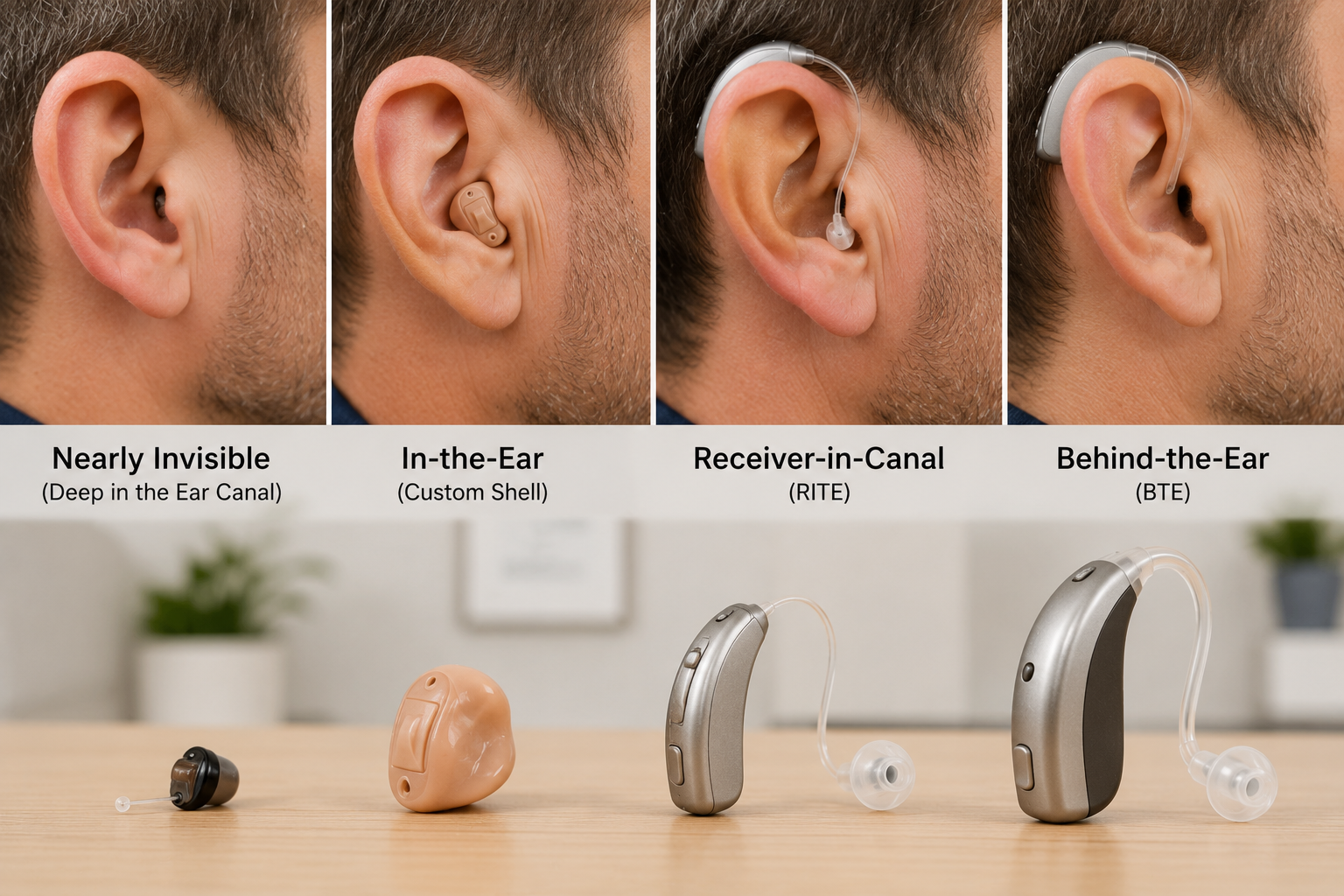
One of the biggest advantages of nearly invisible hearing aids is cosmetic discretion. Unlike behind-the-ear devices, there is no visible casing resting behind the ear or tubing running towards the ear canal. During normal conversation, most people will not realise that the wearer is using hearing assistance unless they look very closely. For some users, this subtle appearance provides greater confidence in both social and professional situations.
Another benefit comes from the device’s position inside the ear. Because the hearing aid sits within the natural ear canal, it can use the ear’s anatomy to help collect and direct sound. Many users describe the listening experience as feeling more natural, particularly when determining the direction from which sounds are coming. The placement also reduces wind noise that can sometimes affect devices positioned behind the ear during outdoor activities.
However, the compact size that makes these hearing aids so discreet also creates certain limitations. Small devices have less internal space for components, meaning battery size is typically reduced. Traditional disposable batteries may require more frequent replacement than those used in larger hearing aids, although advances in battery technology continue to improve performance. Because of the limited space available, rechargeable batteries are not always an option in the smallest invisible models.
Behind-the-ear hearing aids represent one of the most commonly prescribed alternatives. These devices place the main electronics behind the ear while directing sound into the ear canal through a thin tube or wire. Although they are slightly more visible, modern designs have become considerably smaller than older generations and are often difficult to notice beneath hair or from a normal conversational distance.
Behind-the-ear models offer several practical advantages over nearly invisible hearing aids. Their larger size allows manufacturers to include more powerful processors, larger batteries and additional features such as Bluetooth connectivity, advanced directional microphones and longer battery life. They are also capable of managing a much wider range of hearing loss, including severe and profound hearing impairment, making them suitable for many more patients.
Receiver-in-canal hearing aids occupy something of a middle ground. These devices position the speaker inside the ear canal while the main body remains discreetly behind the ear. Many people appreciate this design because it combines excellent sound quality with a relatively unobtrusive appearance. The larger housing behind the ear also provides space for sophisticated processing technology and rechargeable batteries while remaining lightweight and comfortable.
In-the-ear hearing aids provide another alternative. These custom-made devices fill part of the outer ear while housing all electronic components within a single moulded shell. Although more visible than nearly invisible hearing aids, they remain considerably less noticeable than older hearing aid designs. Their larger size makes them easier to insert, remove and adjust, particularly for individuals with reduced finger dexterity or arthritis.
Ease of handling is an important factor that is sometimes overlooked. Nearly invisible hearing aids are extremely small, which can make inserting, removing and cleaning them more challenging. Battery replacement may also require greater precision. For individuals with reduced eyesight, arthritis or limited hand movement, larger hearing aid styles may prove much easier to manage on a daily basis.
Maintenance requirements also differ between styles. Because nearly invisible hearing aids sit deeper within the ear canal, they are exposed to greater amounts of earwax and moisture. Regular cleaning is essential to maintain performance and prevent blockages. Hearing care professionals often provide specific cleaning tools and guidance to help users keep their devices functioning effectively. Larger hearing aids positioned outside the ear canal may require slightly less frequent cleaning, although all hearing aids benefit from regular maintenance.
Technology plays a major role in hearing aid selection. Many larger devices include features such as wireless streaming from smartphones, television connectivity, automatic environmental adjustments and remote programming by hearing care professionals. While some nearly invisible hearing aids also incorporate advanced digital processing, physical size limits the number of features that can be included. Individuals who place a high priority on wireless connectivity or extensive customisation may therefore find larger styles more suitable.
Lifestyle should always influence the choice of hearing aid. Someone who regularly attends meetings, enjoys busy restaurants or frequently uses mobile devices may benefit from hearing aids with sophisticated directional microphones and Bluetooth compatibility. Others who primarily value discretion and require support for mild to moderate hearing loss may find nearly invisible hearing aids provide an excellent balance between performance and appearance.
The fitting process itself is equally important regardless of style. A comprehensive hearing assessment allows an audiologist to measure hearing loss accurately while considering ear anatomy, lifestyle, communication needs and personal preferences. Not every ear canal is suitable for deep-fitting hearing aids, and not every degree of hearing loss can be effectively managed using the smallest available devices. Professional assessment ensures that recommendations are based on clinical suitability rather than cosmetic appearance alone.
Follow-up care also contributes significantly to long-term satisfaction. Hearing changes over time, and hearing aids often require occasional adjustments to optimise speech understanding and listening comfort. Regular appointments allow audiologists to fine-tune settings, monitor hearing health and provide advice on cleaning and maintenance. This ongoing support helps users obtain the greatest possible benefit from their chosen device.
There is no single hearing aid style that is ideal for everyone. Each design offers its own combination of strengths, and the most appropriate choice depends on an individual’s hearing loss, lifestyle, dexterity, cosmetic preferences and desired features. A nearly invisible hearing aid may provide exceptional discretion and natural sound quality for suitable candidates, while larger devices often deliver greater power, longer battery life and more advanced technological capabilities.
The growing variety of hearing aid styles available today means that people no longer need to compromise between effective hearing support and personal preference. By understanding how nearly invisible hearing aids compare with other designs and seeking advice from a qualified hearing care professional, individuals can choose a solution that improves communication while fitting comfortably into their everyday lives. The right hearing aid is ultimately the one that provides consistent hearing improvement, feels comfortable to wear and supports confidence in every listening environment.