A dense metal part made by 3D printing starts as a thin layer of powder, not a solid block. Powder bed fusion 3D printing turns that loose material into a finished component through controlled melting, layer by layer. Producing a useful part, though, depends on careful control of the build, material, heat, and finishing steps.
Table of Contents
- 1 How the Powder Bed Is Built One Layer at a Time
- 2 Why Controlled Melting Matters for Density
- 3 Build Orientation Affects More Than Part Placement
- 4 Support Structures Help Manage the Build
- 5 Metal Printing Is Not the Same as FDM
- 6 Post-Processing Turns the Build Into a Finished Component
- 7 Engineering Decisions Determine Whether the Process Fits
How the Powder Bed Is Built One Layer at a Time
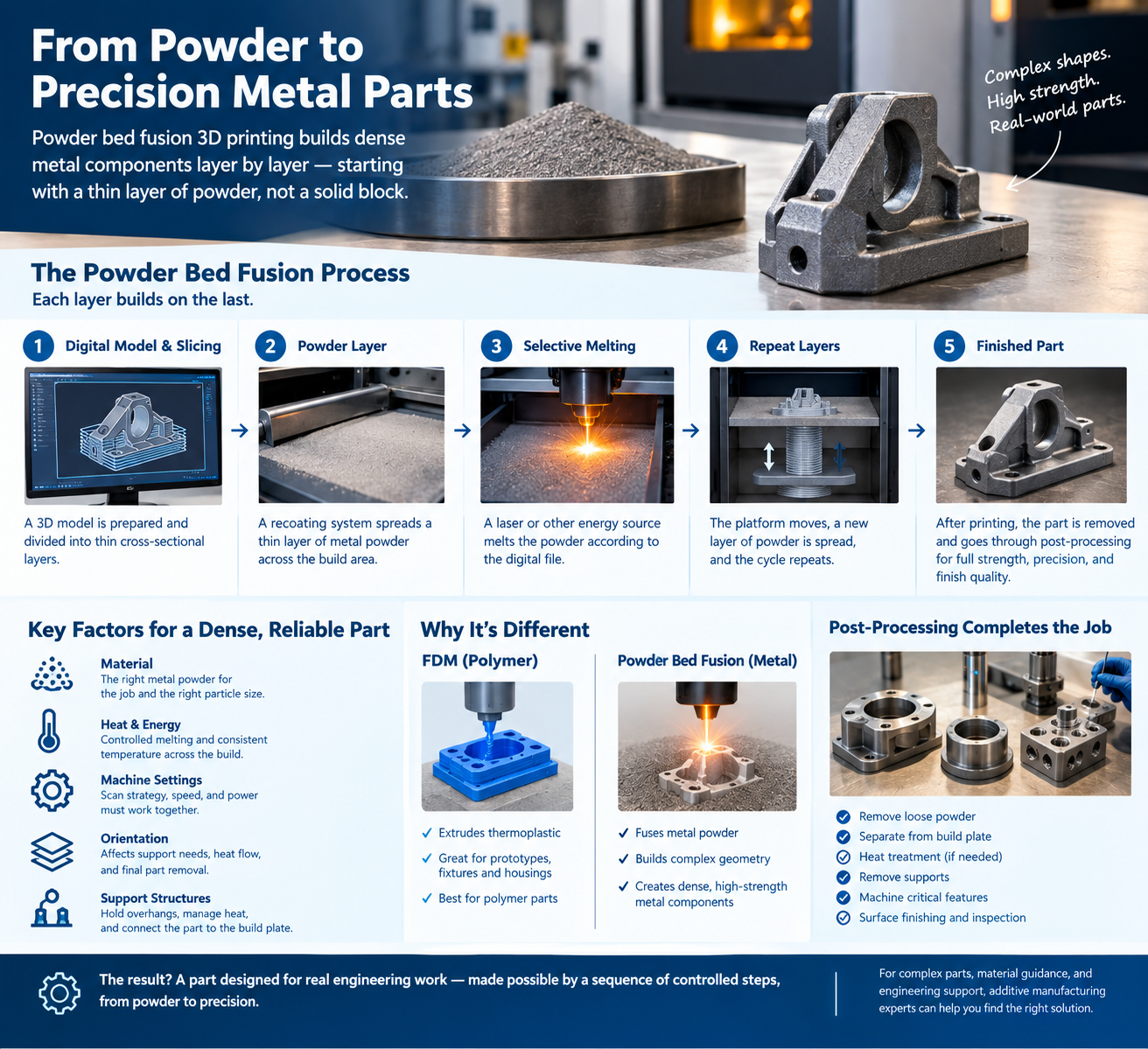
The process begins with a digital 3D model that is prepared for the machine and divided into thin cross-sectional layers. A recoating system spreads fresh metal powder across the build area. A laser or other energy source then traces the geometry for that layer, melting selected areas according to the digital file.
Once the layer is complete, the build platform moves and another coat of powder is spread. The cycle repeats until the part is formed. Unlike conventional machining, which cuts material away from larger stock, additive manufacture creates the component only where material is required. That difference allows the process to build internal features and shapes that cutting tools may not reach.
Why Controlled Melting Matters for Density
Dense metal components depend on more than heating powder until it bonds. The energy source has to melt the material in a controlled way so neighboring scan paths and successive layers join properly. Poor fusion can leave unwanted voids, while excessive heat can create other problems. This is one reason industrial 3D printing requires a managed process. Machine settings, powder characteristics, scan strategy, build orientation, and thermal behavior all influence the finished part. The aim is consistent fusion throughout the geometry rather than a collection of loosely bonded layers.
Build Orientation Affects More Than Part Placement
Orientation is a major part of planning a metal build. Engineers consider where supports are needed, how heat will travel through the component, which surfaces may require finishing, and how the completed part will be removed from the build plate. A different orientation can change support needs and the accessibility of certain features. For Huntsville additive manufacture projects involving complex structures, orientation decisions are often tied closely to geometry and function. A model that looks efficient in CAD may need adjustment before it becomes a practical build.
Support Structures Help Manage the Build
Support structures do more than hold up overhanging geometry. In metal 3D printing, they can also connect a part to the build plate and help move heat away from certain regions. After printing, those supports usually have to be removed.
Good design balances geometric freedom with practical post-processing. A deep internal support that cannot be reached later can create a problem. Engineers may change angles, openings, or internal geometry so the part can be built and cleaned effectively. Rapid manufacturing 3D printing still requires manufacturing judgment even though the physical build begins from a digital file.
Metal Printing Is Not the Same as FDM
People familiar with polymer printing sometimes assume every additive process works the same way. Fused deposition modeling feeds thermoplastic material through a heated nozzle and deposits it in continuous paths. Fused deposition modeling 3D printing is useful for prototypes, fixtures, housings, and many other polymer parts. Powder bed fusion works differently. Instead of extruding a softened polymer, the system selectively fuses metal powder across a bed. Companies comparing metal 3D printing Huntsville AL options should look at the actual process, material needs, part geometry, and finishing requirements rather than treating all forms of 3D printing as interchangeable.
Post-Processing Turns the Build Into a Finished Component
The printing cycle is only part of the job. Once the build is complete, loose powder must be removed and the part separated from the build plate. Depending on the application and material, the production plan may also include heat treatment, support removal, surface finishing, machining, and inspection.
Critical holes, sealing faces, threaded features, or precision interfaces may need secondary machining. That does not reduce the value of additive manufacture. The two methods can complement each other. Printing creates the difficult overall geometry, while conventional finishing handles surfaces that need tighter control.
Engineering Decisions Determine Whether the Process Fits
Powder bed fusion can produce complex, dense metal components, but not every metal part belongs on an additive machine. Simple geometry, large production quantities, easy machining access, or certain finishing requirements may point toward a conventional process instead. The best choice starts with the part rather than the technology.
Powder bed fusion works because each stage supports the next: controlled powder layers, selective melting, thoughtful orientation, support planning, and careful post-processing. Done properly, those steps turn loose metal powder into a component designed for real engineering work.
Additive Manufacturing Engineering can support powder bed fusion 3D printing projects through metal additive manufacturing, design optimization, structural CAD, prototyping, production, and metallurgy-related analysis. These services can help companies evaluate complex part geometry, refine designs for additive production, and address material or structural considerations before moving into a build. For components that also require post-processing or further engineering review, this broader technical support can help connect the printing process with the part’s final manufacturing and performance requirements.