Moving heavy machinery is challenging enough when a building is empty, but the task changes considerably when production must continue around it. An active factory introduces people, vehicles, live utilities, operating machinery, restricted access and production deadlines into an environment where large loads still need to be lifted and moved with precision. In these circumstances, industrial rigging and machinery moving becomes as much an exercise in coordination as engineering, because the relocation team cannot simply take over the site and work without considering everything happening around them. A successful project has to protect workers and equipment while allowing as much of the surrounding operation as possible to continue normally.
The difficulty often begins with space. Production facilities are usually organised to maximise output rather than to leave generous routes for future machinery moves. Equipment may sit between conveyor systems, columns, pipework and storage areas, while the most direct route to an external door may cross working production lines. Even if there is theoretically enough room for the machine itself, additional clearance is needed for lifting frames, forklifts, skates, personnel and controlled turning movements. A route that appears possible on a drawing can become much more complicated once every obstacle is considered at full scale.
This is why detailed site surveys are so important. Before anything is disconnected, the team needs to understand the dimensions and weight of the machine, the available lifting points and the entire route it will follow. Overhead clearance, doorway dimensions, floor capacity and turning space all need to be considered. The survey also has to account for things that may not appear on ordinary building plans, such as temporary storage areas, recently installed barriers or production equipment that has been added since the original layout was created. In an active facility, conditions can also change from day to day, so the planned route may need to be protected from other activities once the move begins.
Production schedules introduce another layer of complexity. A business may not be able to shut the whole plant simply because one piece of equipment needs to be relocated. Instead, the work may need to fit around shifts, planned maintenance windows or quieter periods in the production cycle. This can mean carrying out some stages during evenings, weekends or scheduled shutdowns while preparing other parts of the project in advance. The objective is not merely to move the equipment safely, but to minimise the amount of time that productive machinery is unavailable.
That pressure makes sequencing critical. If several machines are being moved, the order cannot be chosen purely according to which one is easiest to access. Some equipment may depend on upstream or downstream systems, meaning one machine cannot be removed until another has been shut down. Utilities may also serve several pieces of equipment from the same supply, requiring careful isolation so that one section can be disconnected without unnecessarily stopping another. A well-planned move therefore considers production relationships as well as physical location.
Utility isolation can be particularly complicated in older industrial buildings. Machinery may depend on electrical power, compressed air, water, gas, extraction systems, hydraulic supplies or data connections. Before relocation begins, those services must be identified and made safe. The challenge is ensuring that isolating the equipment being moved does not unintentionally interrupt another part of the facility. Clear labelling, updated drawings and coordination with the plant’s maintenance team can prevent costly mistakes.
The people working around the move also have to be considered. Active factories may contain operators, maintenance teams, contractors, delivery drivers and warehouse staff, all following their own routines. Heavy lifting cannot take place safely if people are wandering into the work area or if vehicles continue using the same route. Exclusion zones may therefore need to be created temporarily, with alternative pedestrian and vehicle routes established around them.
Communication becomes especially important here. Staff need to understand which areas will be restricted, how long restrictions are expected to last and what alternative routes should be used. Simply putting up barriers is rarely enough in a busy facility, particularly if normal work patterns have been followed for years. Briefings, signage and coordination with supervisors can reduce the likelihood that someone enters an area because they were unaware that conditions had changed.
Floor loading is another issue that can become more difficult in an operating plant. Machinery may have sat safely in one position for decades, but moving it across the factory places different forces on the floor. Machinery skates, forklifts and hydraulic jacks can create concentrated point loads that are very different from the evenly distributed weight of a machine on its foundation. Underground channels, basements or service ducts can further reduce the load capacity of apparently solid floors.
The planned route therefore needs to be assessed structurally where necessary. Temporary steel plates or other load-spreading measures may be used to protect weaker sections. This work can be particularly challenging if the route crosses areas that still need to remain available for normal operations. The relocation team may have to install and remove temporary protection in stages rather than closing the route for the entire project.
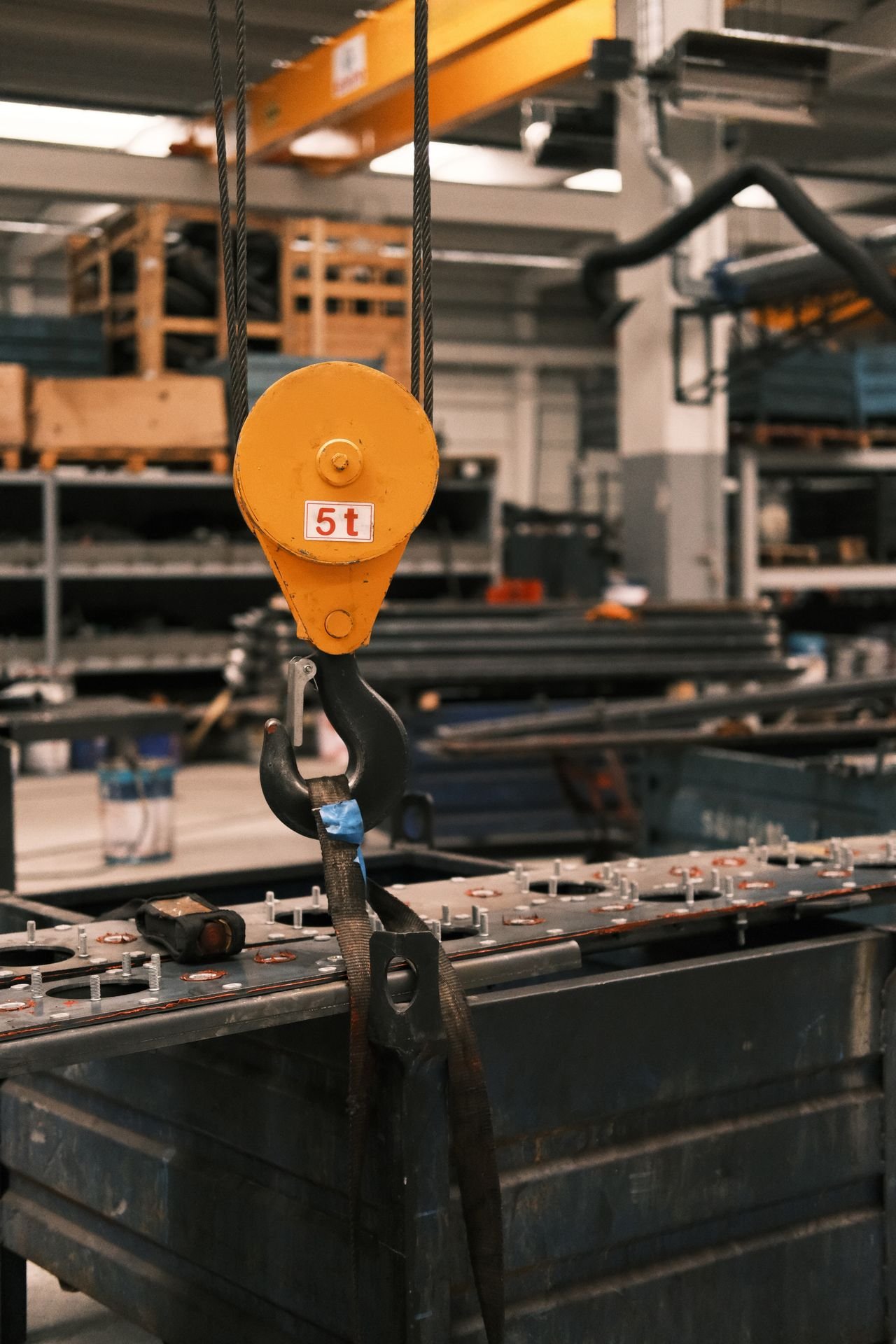
Restricted headroom frequently creates similar problems. Industrial buildings are often full of overhead services, including cable trays, ducting, sprinkler systems and pipework. These can prevent the use of conventional lifting equipment even when there is adequate floor space. Gantries, low-profile jacks or specialised rigging arrangements may be required to lift equipment without interfering with those services.
In some cases, sections of the machine can be removed to reduce its height or weight before movement. Guards, motors, control panels or other components may be transported separately. This makes the move physically easier but creates an additional responsibility: everything has to be documented so that it can be reassembled correctly. Photographs, connection labels and measurements can save considerable time when the machine reaches its new position.
Active production environments also tend to be less forgiving of delays. If a crane arrives late at an empty warehouse, the inconvenience may be limited. If the same delay occurs during a four-hour shutdown window in a working factory, the consequences can be substantial. Production teams may already have stopped machinery, engineers may be waiting to disconnect services and a transport vehicle may be booked for a specific departure time. One delay can therefore affect several other contractors and extend the shutdown beyond the agreed period.
Contingency planning becomes essential. The project team needs to consider what happens if a lifting point proves unsuitable, a vehicle cannot access the planned loading area or the machine takes longer to dismantle than expected. Alternative equipment, additional labour or revised routes may be prepared in advance so that the entire project does not stop when the unexpected occurs.
Transport within the facility can sometimes be more demanding than transport between sites. Once machinery is loaded onto a specialist vehicle, the external journey can be carefully planned around road conditions and restrictions. Inside a factory, however, movement may involve centimetres of clearance, sharp turns and uneven surfaces. Machinery may need to be rotated several times or transferred between different handling systems before reaching the loading point.
These movements require precise control. Heavy machinery carries enormous momentum even when moving slowly, so the team needs to understand exactly how the load will behave. Sudden changes of direction or poorly controlled slopes can create risk. Communication between the people controlling the movement needs to be clear, with one person typically directing the operation so that conflicting instructions are avoided.
The condition of the machinery itself can create further challenges. Older equipment may not have obvious lifting points, or original lifting instructions may no longer be available. Modifications made during years of service can alter the weight distribution significantly. A machine that once had a predictable centre of gravity may now contain additional motors, tanks or attachments that shift its balance.
This means assumptions based solely on the original specification can be dangerous. Equipment may need to be inspected carefully, and sometimes a small test lift is used to confirm how the load behaves before it is moved fully. Components may also need to be secured internally so that they do not shift during lifting or transport.
Protecting nearby production equipment matters just as much as protecting the machine being moved. A suspended or rolling load can pass close to operational assets worth considerable amounts of money. Contact with a neighbouring machine, electrical cabinet or production line could cause damage and extend the shutdown far beyond the original scope of the relocation.
Temporary barriers and protective coverings may therefore be installed where clearances are tight. In some situations, nearby equipment may need to be stopped briefly while the load passes, even if the broader production line remains active. This requires careful coordination so that short interruptions occur at the least disruptive time.
Once the machine reaches its new position, the pressure does not disappear. Reinstallation must often happen quickly so that production can resume, but accuracy cannot be sacrificed for speed. Machinery may need to be levelled, aligned and anchored within precise tolerances. Utilities have to be reconnected correctly, and surrounding safety systems must be restored before operation begins.
Commissioning then provides the final test of whether the relocation has been successful. Electrical and mechanical checks are typically completed before the equipment is run, followed by gradual testing under increasing load. Vibration, temperature, alignment and production output may all need to be monitored. If baseline readings were recorded before the move, they can help determine whether the machine is performing as expected in its new location.
Operators can be extremely useful during this stage because they know how the machine normally sounds and behaves. An experienced operator may notice a subtle vibration or change in performance that is not immediately obvious from instrumentation. Including them in the commissioning process can therefore help identify issues before normal production resumes fully.
What makes relocation inside an active production facility so demanding is that almost every decision affects something else. Closing an aisle may interfere with warehouse operations. Isolating a utility may affect neighbouring machinery. Extending a lifting operation may interfere with the next shift. Even a technically straightforward machine move can become complicated once these dependencies are added.
That is why the best projects are planned around the factory as a living operation rather than treating the machinery as an isolated load. The move needs to fit into the wider production environment, with engineering, safety, logistics and operational requirements considered together. When that coordination is done well, heavy equipment can be relocated without bringing an entire facility to a halt. The machinery still needs to be lifted and positioned accurately, but managing everything around the lift is often what determines whether the project truly succeeds.